
CoursesDesigning to Care: Improving Health and Wellness
NURS 3200

Designing to Care: Improving Health and Wellness

Designing to Care is informed by ideas and skills from across the disciplines of design, nursing, and health research. As an interdisciplinary and project-based course, it actively examines the connection between the design of healthcare, how we communicate health strategies, and the impact of both on individual, institutional, and community wellbeing.


Wednesdays, 3:30 PM – 6:29 PM

Through this course, students are exposed to the content (evidence, research, and misconceptions) and the context (people, places, and systems) that impact health as we generate compelling human-centered design and science-based strategies that can impact the lives of those who live within and beyond our local Philadelphia community. It culminates in the ideation, development, and realization of a collaborative project that strategically communicates, educates, or otherwise works to improve health at the individual, institutional, or community level.

The course includes direct, project engagement and guest lectures from healthcare, design, communication, and health research professionals. It incorporates targeted skill building and software training, individual and group activities, class conversations and critiques, and community engagement. From this foundation, the goal is to create real, implementable, and innovative solutions to health and healthcare challenges that embody design in action.

Students with a semester level of Freshman may not enroll.
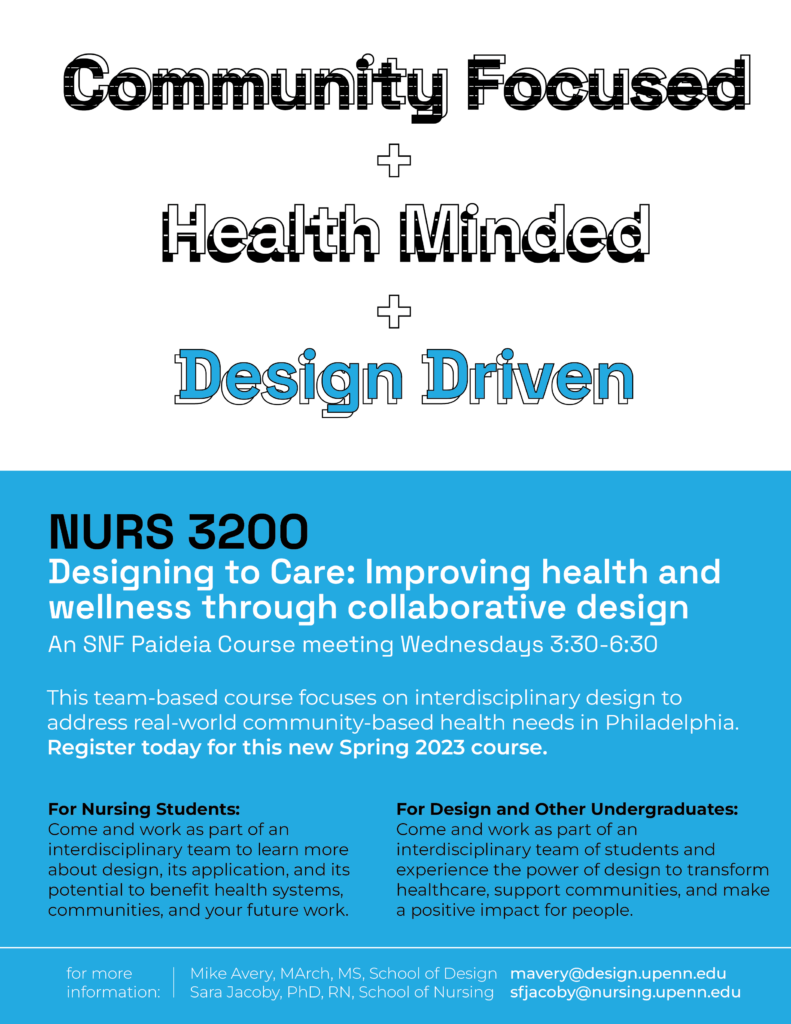
graphic flyer for designing to care

Section Attributes
  • Designated SNF Paideia Program Course (UNPP)
  • NU Sector Society and Soc Struct (NUSS)
Related Content

Other Courses of Interest

COGS 4001

The Cognitive Science of Conversation

Instructor(s)

  • Nora Bradford

Semester

Spring 2027

What makes a conversation “good”? How do we achieve the feeling of being “on the same page” with an interlocutor? This course explores the neurological and cognitive underpinnings of effective communication, equipping students with the scientific knowledge necessary to foster constructive dialogue. 


Learn More
BENF 2240

The Crisis of Expertise

Instructor(s)

  • Tal Arbel

Semester

Spring 2027

In recent years, there has been intensive talk about a “crisis of expertise” unfolding in liberal-democratic societies. Along with suspicion toward established facts and institutional findings, techno-scientific experts – academic researchers, medical doctors, engineers, public health specialists – are widely seen as detached elites whose impartiality is questionable, and motivations can no longer be trusted. This concerning shift in public attitudes, the argument goes, has boosted the popularity of unverified and unregulated sources of knowledge (traditional healing practices, the wellness industry, social media influencers, self-tracking), and given rise to a dangerous “do your own research” (DYOR) culture that impedes our collective ability to distinguish sound advice from misinformation.

Learn More