
CoursesAmerican Monuments: Designs for the Future
HIST 164-001

American Monuments: Designs for the Future

The 2020 protests about monuments in Philadelphia and across the nation have exposed this truth: Arguments over the past are arguments about the future. This place-based course examines local and national public memory in relation to the built environment. Students will learn about the making of the U.S. memorial landscape in the long nineteenth century, its remaking in the twentieth century, and its possible futures in the (un)making.

Thursdays, 3:30 PM – 5:00 PM

Initial lectures and readings will cover a variety of commemorative structures and practices, from the permanent and the material to the ephemeral and the virtual. The instructor will provide international, national, and local context, including an overview of Philadelphia history. But the heart of the course will be group projects based on deep engagement with sources. Working in teams, students will analyze memorial landscapes, past and present, of Greater Philadelphia, of West Philly, and of Penn’s campus. Your final assignment will be a proposal—or an actual staging—of a “memory work” of your own design. The overall goal of the course is to join the academic and the civic, town and gown.
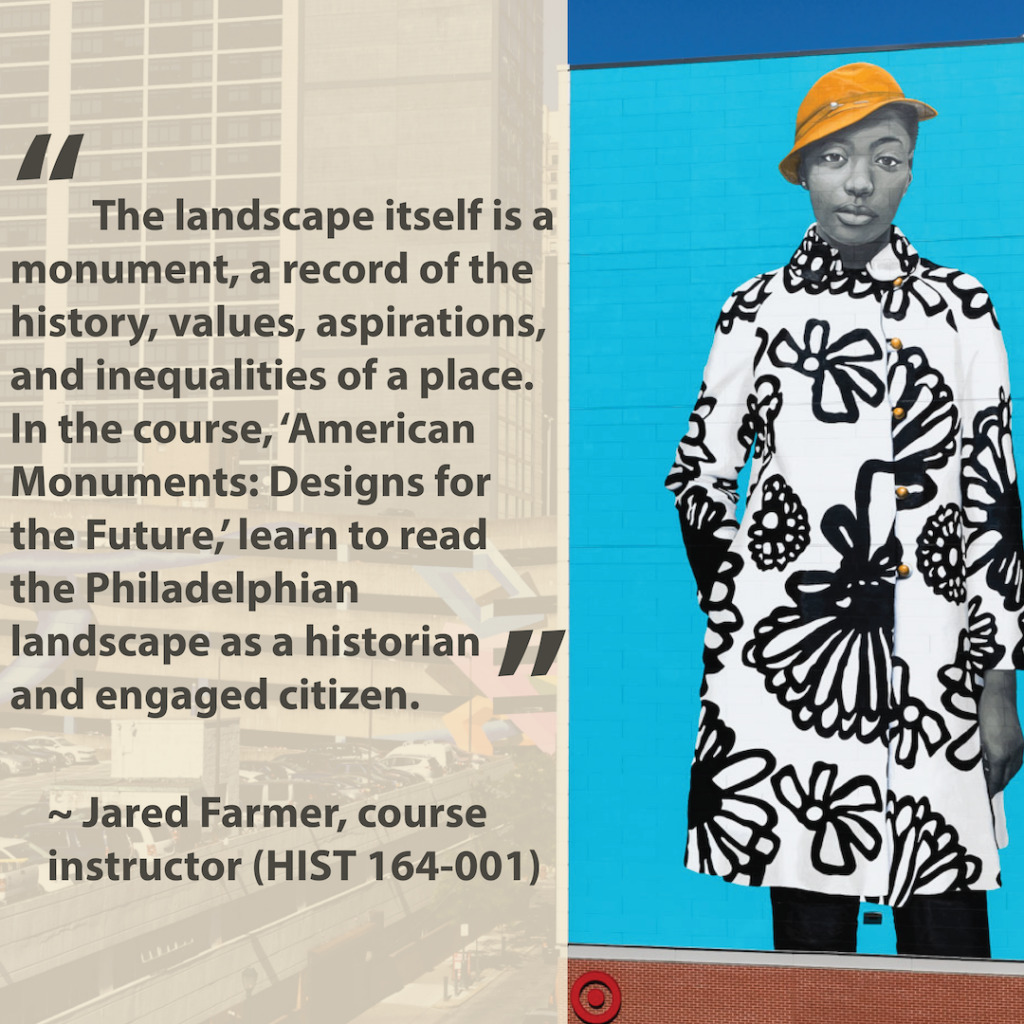
portrait is of Najee S. by Amy Sherald

Working Syllabus

Other Courses of Interest

HSOC 3210

Health in Philly: Past and Present

Instructor(s)

  • Andi Johnson

Semester

Fall 2025

How have different neighborhood organizations, activist groups, and private and public institutions in Philadelphia tried to understand and address shared health problems? How have Philadelphia organizations, groups, and institutions promoted wellbeing? In this course with a field work component, students will read about neighborhood- and community-based interventions into health in Philadelphia since the turn of the 20th century.


Learn More
URBS 1400 - 301

Inequity and Empowerment: Urban Financial Literacy

Instructor(s)

  • Brian Peterson

Semester

Fall 2025

This course provides students with a rich look at the historical and contemporary factors that have shaped America’s wealth gaps. By studying the economic impacts of systemic forces such as discriminatory housing, predatory lending, and unbanking, students will develop a deep financial understanding of today’s urban communities.

Learn More